
The Fairfield County Homeowner’s Guide to Buying Gutters
What to look at, what to ask, and how to compare quotes before you sign anything. With town-by-town notes for every Fairfield County town of 15,000 or more residents.
If you are shopping for gutters, you have probably noticed that every estimate looks a little different and every installer says something slightly contradictory. This guide is meant to fix that. By the end of it you should be able to read a gutter quote, understand what you are paying for, and know which questions separate a good installation from one you will be replacing in ten years.
I’m George Curi. I live in Newtown, and I own George’s Seamless Gutters. My crews install and replace gutters across Fairfield County, so everything below comes from what actually holds up on houses here, not from a product catalog.
Why Gutters Are a Bigger Deal in Fairfield County

Gutters have one job: catch the water that runs off your roof and move it away from your foundation. That sounds simple until you account for what this county throws at them.
- Mature trees. Most of our neighborhoods are heavily wooded. Oak, maple, and pine drop leaves, seed pods, and needles for most of the year, and that debris ends up in your gutters.
- Snow and ice. Gutters here carry real weight in winter. Ice dams, sliding snow, and repeated freeze-thaw cycles pull undersized or poorly hung gutters off the fascia.
- Heavy rain. Summer storms and fall nor'easters dump a lot of water fast. A gutter system that is too small overflows at the exact moment you need it most.
- Salt air. Along the Long Island Sound shoreline, salt accelerates corrosion on fasteners, steel, and scratched coatings.
- Wet basements and foundations. Much of the county has clay-heavy soil, ledge close to the surface, and older stone or block foundations. Water that lands next to the house tends to end up inside it.
- Septic systems. In the northern and eastern towns, most homes are on septic. Roof runoff dumped near a leach field can saturate it and shorten its life.
A standard gutter job designed for a milder climate will often underperform here. Keep that in mind as you read the rest of this guide.
How gutter style and color change the look of your home
Gutters run along every roof edge on the house. They are one of the longest continuous lines on the exterior, and they either blend into the architecture or fight it. Most homeowners never think about this until they see a house where the choice was wrong.

K-style has a flat back and a front shaped like crown molding. It reads as trim. On a colonial, cape, or contemporary with existing crown molding or a built-up fascia, K-style continues that line and mostly disappears. It is the default for good reason.

Half-round is a simple U. It reads as a distinct element, a bit like period plumbing, and it is what you see on antique homes, farmhouses, and many of the larger older properties in Ridgefield, New Canaan, Wilton, and Greenwich. Half-round paired with round downspouts and decorative brackets is the traditional look, and on the right house nothing else looks correct. On a 1990s colonial it looks like a costume.

Box or fascia-style gutters have a tall, flat face and are common on modern and commercial-style homes with clean lines and no trim detail. They suit flat-roofed and contemporary houses, including some of the mid-century homes in New Canaan.
The rule of thumb: match the profile to the age and style of the house, not to what is popular this year. Homes with curved eaves, bay windows, or turrets need radius gutters formed to the curve; a straight gutter forced around a bend will leak at every joint.

There are three ways to handle gutter color, and each sends a different message. Factory color gutters come in a wide palette, and we can match trim, siding, or roof samples.
Blend with the trim. White or almond gutters on white trim is the most common choice in the county, and it is the safest. The gutter reads as part of the fascia and the eye moves past it. If you want the gutters to be invisible, this is how.
Match the roof or siding. Brown, bronze, or gray gutters against a similar roof or dark siding make the roofline look thicker and the house look more grounded. This works well on ranches, capes, and homes with wide overhangs, where the gutter is a large part of what you see from the street.
Contrast on purpose. Black gutters and downspouts on a white or light gray house is the look that has taken over new construction and renovations in Westport, Darien, and Fairfield. It frames the roofline like eyeliner and pairs with black windows and a dark front door. It only works if the rest of the house is committed to it; black gutters on an otherwise traditional white colonial with white windows look like a mistake. Dark bronze is a softer version of the same idea.
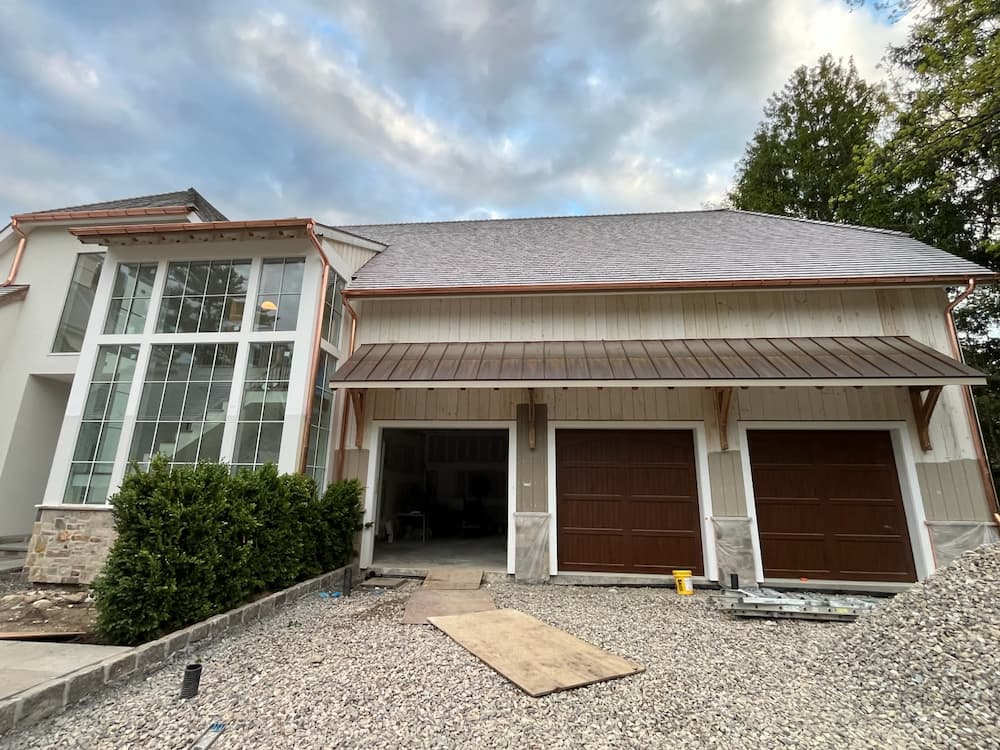
Copper is its own category. It starts bright, dulls to brown within a year or two, and settles into green over decades. It says the house is old, expensive, or both, and on the right property it is the single best-looking gutter you can install. Expect it to patina faster near the shoreline. If you want the look without the price, faux copper gutters are copper-toned aluminum that never patinas. If you want copper’s durability without the color change, lead-coated copper stays a soft gray.

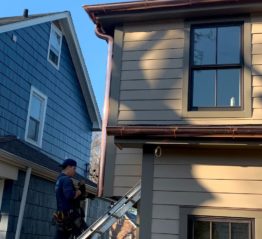
Downspouts are vertical lines cutting across your siding, and their placement matters as much as their color. A good installer runs them at inside corners, behind columns, or next to trim boards so they disappear. A careless one drops them in the middle of a wall. When you review a quote, ask where each downspout will land and why. Color-matching downspouts to siding rather than to the gutter is a common trick for hiding them on a home with contrasting gutters.
If you are unsure, match the trim. It is never wrong. If you are redoing windows, doors, or siding, choose gutters at the same time so the whole exterior makes one decision. And if you are drawn to black or copper, look at three houses that already have it before you commit.
How Gutter Size Affects Water Flow

Gutter size is the decision most homeowners never make, because most installers never offer it. It is also the one that determines whether the system works in a real storm.
A gutter’s capacity is set by its cross-section. Going from a 5-inch to a 6-inch K-style adds one inch of width, but it also adds depth, so the channel holds roughly 40 percent more water. Downspouts scale the same way: a 3×4-inch downspout has about twice the opening of a 2×3, and the larger opening also clogs far less because a wet clump of leaves that would bridge a 2×3 outlet drops through a 3×4.
Water flow through a gutter is limited at three points: how much the trough can hold before it spills over the front edge, how fast the downspout outlet can drain it, and how fast the downspout itself can carry it down. Undersize any one of the three and the gutter overflows even when it is spotless.
These are the industry starting points, based on a heavy 1-inch-per-hour rainfall and a moderate roof pitch. Steeper roofs and metal roofs push more water into the gutter faster and move you toward the larger size sooner.
| Component | Handles roughly | Typical use |
|---|---|---|
| 5-inch K-style gutter | Up to about 5,500 sq. ft. of roof area | Most single-family homes |
| 6-inch K-style gutter | Up to about 7,900 sq. ft. of roof area | Large homes, steep or metal roofs, long runs |
| 2x3-inch downspout | About 600 sq. ft. of roof area each | Standard with 5-inch gutters |
| 3x4-inch downspout | About 1,200 sq. ft. of roof area each | Standard with 6-inch gutters; recommended anywhere |
The roof area that matters is the section draining into that particular gutter run, not the whole roof. A single long run collecting water from a large rear roof section may need 6-inch gutters and two 3×4 downspouts even when the rest of the house is fine with 5-inch.

When to size up
Ask for 6-inch oversized gutters and 3×4 downspouts if any of these apply:
- The roof is steep (roughly 8/12 pitch or more)
- Any roof section is standing seam or other metal
- A valley drains into the gutter
- Any single run is longer than 40 feet
- The existing gutters overflow even when clean
- The house is two and a half stories or taller, so the roof area per run is large
Half-round gutters carry less water per inch of width than K-style, so a 6-inch half-round is closer to a 5-inch K-style in capacity. If you are choosing half-round for the look, size up to compensate.
Pitch and downspout count
Two more things determine flow. Gutters need a slight slope toward the downspout, about a quarter inch for every ten feet, so water moves instead of sitting and freezing. And every run needs enough downspouts: one for every 30 to 40 feet is the usual minimum, with more for 6-inch systems or high-volume roof sections. A low quote often gets there by trimming the downspout count, which no one notices until the first nor’easter.
Seamless vs. Sectional
Sectional gutters come in pre-cut lengths that are joined together on your house with connectors and sealant. They are what you find at the home center. Every joint is a future leak, and in freeze-thaw conditions those joints fail faster.
Seamless gutters are formed on site from a continuous coil, cut to the exact length of each run. The only seams are at corners and downspout outlets. Fewer seams means fewer leaks, less sagging, and a cleaner look.
For a home in Fairfield County, seamless is the right answer nearly every time.
Materials: what they cost you in the long run
Aluminum
Aluminum is the standard for a reason: it does not rust, it is light enough to hang securely, and it comes in a wide range of factory colors. The detail that matters is thickness. Most aluminum gutter coil is either .027 inch or .032 inch. The thicker .032 material resists bending from ladders, ice, and snow load noticeably better. If a quote does not state the gauge, ask.
Color-Coated Aluminum
Color-coated aluminum is the same material with a baked-on finish matched to your trim, siding, or roof. The finish is durable; what you are paying for is the look. Coated aluminum is also the practical choice near the shoreline, where the finish protects the metal from salt.
Copper
The premium option. Copper outlasts the rest of the house, develops a patina over time, and looks right on the historic and high-end homes common in Ridgefield, Westport, New Canaan, and Greenwich. It costs several times what aluminum does and requires an installer who solders joints rather than seals them. Ask to see a previous copper job.
Galvalume and Galvanized Steel
Steel is stronger than aluminum and handles heavy snow and ladder abuse well. Galvalume (a zinc and aluminum coating) resists corrosion better than plain galvanized steel, which can rust once the coating is scratched. Steel suits large homes, barns, and outbuildings. It is a poor fit for the shoreline.
Vinyl
We do not install it and would not recommend it here. It becomes brittle in cold weather, sags under snow, and the joints separate.
| Material | Best for | Watch out for | Relative cost |
|---|---|---|---|
| Aluminum (.032) | Most homes; the default | Thinner .027 coil on cheap quotes | $ |
| Color-coated aluminum | Matching trim; shoreline homes | Scratches during install expose bare metal | $ |
| Copper | Historic, high-end, antique homes | Needs soldered joints; patinas fast near salt air | $$$$ |
| Galvalume steel | Large homes, barns, heavy snow | Not for salt air; rusts where scratched | $$ |
| Galvanized steel | Budget heavy-duty inland | Rusts once coating wears | $$ |
| Vinyl | Not recommended in this climate | Brittle in cold, sags, joints separate | $ |
The Parts That Determine Whether the System Actually Works
Hangers. Hidden hangers screwed into the fascia are the current standard and are far stronger than the old spike-and-ferrule method. Spacing matters: 24 inches is typical, but for snow load in our climate, 16 to 18 inches is the better spec. Near the shoreline, ask for stainless steel screws.
Elbows, extensions, and where the water goes. Extensions should carry water at least 4 to 6 feet from the foundation, or connect to underground drainage. Options, from simplest to most involved:
- Splash blocks and surface extensions. Cheap and effective on lots that slope away from the house.
- Buried downspout drains. Solid PVC pipe running to daylight on a downhill part of the lot. The best long-term option where grading allows it.
- Dry wells. A buried chamber that lets runoff soak into the ground. Works in sandy soil; performs poorly in the clay and ledge common in much of the county. Ask about a perc test first.
- Rain barrels. Fine for a garden, but a single barrel fills in minutes in a real storm. Plan for the overflow.
Fascia and drip edge. If the fascia is rotted, soft, or missing a drip edge, the gutter has nothing solid to hang from. On older homes, soffit and fascia repair is the most common surprise on a gutter job, so ask for it to be priced up front.
Corners and end caps. On seamless aluminum, corners are the only seams that remain. Ask whether they are box (mitered) corners or strip miters, and what sealant is used. On copper, corners should be soldered, not caulked.
Gutter Guards: A Candid Take
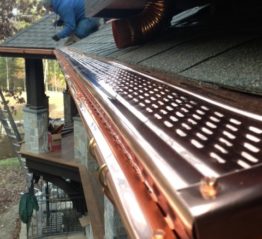
Gutter guards are worth considering here because of the tree cover, but they are not maintenance-free and no honest installer will tell you they are. We covered the cost side in Are Gutter Guards Worth It in Connecticut?
- Micro-mesh guards block the widest range of debris, including pine needles and shingle grit, and are the best fit for most wooded lots.
- Perforated or screen guards are less expensive and work well against leaves but let smaller debris through.
- Reverse-curve (surface tension) guards shed leaves well but can overshoot in heavy rain and struggle with ice.
- Foam or brush inserts are cheap and easy to install, but they trap seeds and grit, grow moss, and usually need replacing within a few years.
Whichever you choose, the guard should be sized to the gutter, should not raise the front edge in a way that causes overshoot, and should not be slid under the first course of shingles, which can void a roofing warranty. On copper systems, copper gutter guards match the gutter and patina with it. Even guarded gutters need a periodic gutter cleaning or screen cleaning.
Ice Dams, Heat Cables, and Winter
Gutters do not cause ice dams. Ice dams form when heat escaping the attic melts snow on the upper roof and the meltwater refreezes at the cold eave. The fix is attic insulation and ventilation. What gutters do is give that ice a place to build up and add weight, which is why hanger spacing and coil gauge matter so much here.
Heat cables in the gutters and downspouts can keep a drainage path open through the winter. They are reasonable on north-facing eaves and on homes where insulation upgrades are not practical, but they treat the symptom, not the cause.
Repair or Replace?
Gutter replacement is usually the right call when you see:
- Sagging or pulling away from the fascia in multiple spots
- Seams leaking in several places on a sectional system
- Rust on steel gutters or corrosion on aluminum
- Repeated overflow despite clean gutters (a sizing problem)
- Water stains on siding or in the basement traced to the gutters
Gutter repair makes sense for an isolated loose hanger, one bad corner, a clogged downspout, or a single damaged section on an otherwise sound system. Small problems left alone rarely stay small; see The Hidden Cost of Ignoring Small Gutter Problems. And not every stain at the roofline is a gutter problem; soffit and fascia issues are often mistaken for roof leaks.
How to Read and Compare a Gutter Quote
Every estimate should clearly state:
1. Material and gauge (for example, .032 aluminum, 16 oz copper)
2. Profile and size (5-inch or 6-inch K-style, half-round)
3. Color, with the manufacturer’s color name
4. Downspout size and count, and where each one discharges
5. Hanger type and spacing
6. Whether old gutters are removed and hauled away
7. Fascia inspection and any repair pricing
8. Guards, if included, with the specific product named
9. Warranty, separated into workmanship and material
10. Proof of insurance, both liability and workers’ comp
11. Connecticut Home Improvement Contractor registration number
A low quote often gets there by using thinner coil, wider hanger spacing, fewer downspouts, or 2×3 downspouts where 3×4 belong. None of that shows up on the day of the install. It shows up two winters later.
Questions Worth Asking Any Installer
- What gauge coil do you run?
- How far apart do you place hangers, and what do they screw into?
- How many downspouts, and why that number?
- What happens to the water once it leaves the downspout?
- Have you installed this material and color on a home like mine? Can I see it?
- Who is on the job: your crew or a subcontractor?
Town by Town: What Changes the Gutter Conversation Where You Live
Shoreline Towns
Everything on or near Long Island Sound shares three things: salt air, older housing that has been renovated many times, and low-lying neighborhoods where drainage is a real concern. Across these towns, favor coated aluminum or copper, ask for stainless fasteners, and pay extra attention to where downspouts discharge. Homes in mapped flood zones may face limits on grading and drainage changes, so check with the town before adding buried drains.
Greenwich. Shoreline neighborhoods in Old Greenwich, Riverside, and Byram, and large backcountry properties north of the Merritt. Shoreline homes need salt-resistant materials. Backcountry homes have very long eave runs and multiple roof sections, which means more downspouts and careful pitching from the center of long runs. Copper half-round is common on the larger and older homes, and the historic districts have design review. See a recent Greenwich copper gutter installation on new construction. Cos Cob homeowners can start with our Cos Cob page.
Stamford. South of the Merritt, and especially in Shippan, the Cove, and Waterside, salt exposure and narrow side yards make downspout placement tricky; buried drains to the street or rear yard are often the answer. North Stamford is wooded and hilly with larger lots and heavy leaf drop, and needs what the inland towns need: 6-inch gutters and micro-mesh guards.
Darien. Older colonials and capes that have been expanded or rebuilt, often with complex rooflines and many corners. Salt exposure is high near Noroton Bay and Long Neck Point. Newer construction here often runs 6-inch gutters and 3×4 downspouts as standard; older homes benefit from the same upgrade. Black gutters on white siding are everywhere in the newer builds, and copper on the shoreline homes.
Norwalk. Coastal neighborhoods in Rowayton and East Norwalk, plus a large inventory of older single-family and two-family homes inland. Low-lying areas near the harbor and the Norwalk River flood, so getting runoff away from the house is the priority. On two-family homes, make sure the quote covers porch roofs and flat additions that drain separately.
Westport. A high rate of teardown and rebuild, with standing seam metal roof accents, steep pitches, and black or dark bronze gutters on the new homes. Metal roof sections need 6-inch gutters and snow guards. Compo, Saugatuck Shores, and Greens Farms need salt-resistant materials. The downtown and Kings Highway North historic districts have design review.
Fairfield. The beach area and Southport sit low and salty, and many homes there are in flood zones. Southport has a historic district. Inland, post-war capes and colonials on modest lots with mature trees close to the house. Coated aluminum with micro-mesh guards is the practical answer for most Fairfield homes, and the conversation should center on where the downspouts drain.
Bridgeport. The county’s densest and oldest housing stock, with many two- and three-family homes. Flat or low-slope roof sections drain through scuppers and leaders rather than eave gutters and need separate inspection. Narrow lots mean downspouts often run to the street or a rear drain. Salt is a factor in Black Rock and the South End. Heavier-gauge aluminum or steel holds up against the ladder traffic that multi-family maintenance brings.
Stratford. Lordship sits on a peninsula between the Sound and the Housatonic and has the highest salt exposure in the county, plus flood-zone restrictions. The rest of town is mid-century capes, ranches, and colonials on flat clay lots where water pools rather than drains. Buried drains to daylight are not always possible on flat lots, so extensions and grading become the focus.
Inland and northern towns
Away from the shore, the county rises into wooded, hilly terrain with larger lots, more snow, and a heavy reliance on well and septic. Micro-mesh guards, 6-inch gutters, and tighter hanger spacing earn their cost here.
Danbury. Dense older neighborhoods and condominiums near downtown, newer subdivisions on the hills, and waterfront homes on Candlewood Lake. Lake homes sit under heavy tree cover on steep lots, which makes guards and buried drains worthwhile. Higher elevations see more snow than the shoreline, so ask for 16 to 18 inch hanger spacing. On condominiums, confirm what the association covers first.
Bethel. Hilly and wooded, with older village homes near Greenwood Avenue and mid-century and newer subdivisions on larger lots. Leaf and pine needle load is heavy, and many lots slope toward the house. The focus is guards, downspout count, and getting discharge to the downhill side.
Brookfield. Fronts both Candlewood Lake and Lake Lillinonah, and lakefront homes share the steep, tree-heavy conditions of the Danbury lake neighborhoods. Inland, colonials and raised ranches on wooded lots with septic. Keep discharge away from the leach field, and on steep lots ask for buried drains rather than surface extensions that erode the slope.
Newtown. This is home for me. Large wooded lots, a lot of ledge and clay, long colonials with 60-foot eave runs, and almost everyone on septic. Lake Zoar and Lake Lillinonah waterfront homes deal with steep slopes and heavy tree cover. Dry wells rarely work here because of the soil, so buried drains to daylight are the usual answer. The Main Street historic district has design review, and copper half-round is common on those homes.
Ridgefield. One of the higher elevations in the county, with noticeably more snow and ice than the shoreline, so hanger spacing and coil gauge matter more here than almost anywhere else. The Main Street historic district and the many antique homes call for copper half-round. Newer homes on the outer roads are large colonials with steep roofs; size up to 6-inch.
Wilton. Heavily wooded, with many antique homes and mid-century ranches along the Norwalk River. Low lots near the river stay wet. Leaf load is among the heaviest in the county; micro-mesh guards are close to mandatory if you want to avoid cleaning three times a year.
New Canaan. Known for mid-century modern houses with flat or low-slope roofs, internal drains, and scuppers, which need an installer who understands that approach; a standard gutter quote will not cover it. The rest of town is large colonials and antique homes where copper and half-round are common and the historic district has design review. Snow load is a real consideration at this elevation.
Housatonic Valley towns
Shelton, Trumbull, and Monroe run along the Housatonic and Pequonnock valleys. Inland, wooded, and hilly, with denser and more mid-century housing than the northern towns. Salt is not a factor. Leaf load, steep lots, and clay soil are.
Shelton. An older downtown and Huntington neighborhoods with mid-century capes and colonials, plus newer construction on the hills toward Monroe and Trumbull. Many homes have one side well below grade, and that side is where water collects. Point downspouts downhill and use buried drains where the slope allows.
Trumbull. Post-war capes, ranches, and colonials on wooded half-acre to acre lots with mature oaks close to the house. Most homes are on public sewer, so the conversation is about guards, adequate downspouts, and getting water past the foundation plantings that sit right against so many of these houses.
Monroe. Newer colonials and raised ranches on large wooded lots, nearly all on well and septic. Keep discharge well away from the leach field and the well head. Roofs are often steep with multiple gables, which means more corners and more downspouts. Six-inch gutters and micro-mesh guards are the standard recommendation.
Towns under 15,000
Weston, Redding, Easton, New Fairfield, and Sherman are not covered above, but the inland and northern notes apply to all of them. New Fairfield and Sherman share the Candlewood Lake conditions described under Danbury and Brookfield.
Keeping the System Working After the Install
- Late spring: clear seed pods and pollen mats, check that extensions survived the winter and the lawn crew.
- Late fall, after leaf drop: clean or inspect guards, confirm every downspout runs free, check for standing water.
- After any major storm: walk the house during rain and watch for overflow or water sheeting behind the gutter.
- Every few years: check hangers for movement and re-seal corners on aluminum systems.
When You're Ready

If you are in Newtown or anywhere in Fairfield County and want a straight answer on what your home needs, my team will come out, look at the roof, the fascia, and the drainage, and give you a written quote that answers every item on the checklist above. We install seamless aluminum, color-coated aluminum, copper, and steel systems, and we handle gutter guards, repairs, cleaning, and full replacements. Every crew member is in-house; we do not use subcontractors.
Request an estimate or call or text 844-512-2426, and we’ll take it from there.