
What Every Home Buyer in Fairfield County Should Know About Roofs and Gutters

Buying a home is one of the most significant decisions most of us will ever make. And in Fairfield County, where the housing stock ranges from grand Victorians in Bridgeport’s historic neighborhoods to shingle-style cottages in Westport, classic New England Colonials in Darien and New Canaan, and everything in between, that decision comes with many moving parts. Location. Schools. Commute. Price per square foot. Neighborhood character.
But here is one factor that buyers overlook more often than almost any other: the true condition of the roof and gutter system.
My name is George Curi. I live in Newtown, CT. I coach the Blue Hawks girls’ soccer team, and I have been helping homeowners throughout Fairfield County protect and maintain their homes for years. As the owner of George’s Seamless Gutters, I have seen roofs and gutter systems in every condition imaginable, on homes in every price range, and I can tell you with confidence: the roof and gutters are among the first things you should understand when you are evaluating a home to buy.
This guide is my attempt to give you the knowledge you need before you sign. Consider it a gift from a neighbor who wants you to start your homeownership journey on the right foot.
Why Roofs and Gutters Matter More Than You Think
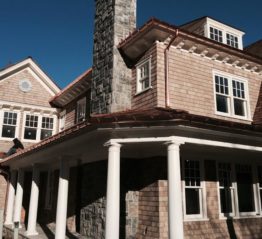
Different architectural styles have genuinely different needs, and the gutter solution that looks magnificent on a Tudor Revival can look awkward and out of place on a Cape Cod. Let’s go through the most common home styles in Fairfield County and what works best for each.
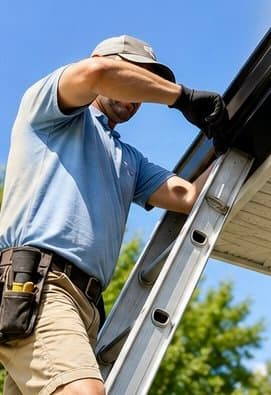
Gutters in particular are easy to overlook during a showing, especially on a sunny day. They sit quietly along the roofline doing their job, and when they work well, nobody notices them. But when they are not working well, the consequences are anything but quiet. Water overflows against the siding. It pools at the foundation. It finds its way into basements and crawl spaces. It rots fascia boards and damages soffits. All of this happens gradually and often invisibly, until it cannot be ignored.
“George thinks the roof and gutter system is one of the most telling things about how a home has been cared for,” Michael notes. “A seller who has kept the gutters clean and the roof maintained has almost certainly taken good care of the rest of the house, too. And the reverse tends to be true as well.”
Fairfield County’s climate makes all of this especially relevant. Last winter brought multiple nor’easters, sustained freezing temperatures, and significant ice accumulation across the region. Ice dams formed on homes with clogged or undersized gutters, forcing meltwater up under shingles and into attics. Fascia boards cracked. Gutters pulled away from rooflines under the weight of ice and packed snow. This past spring, heavy rainfall in March and April put drainage systems under intense pressure. And as we head into summer, forecasts call for above-normal temperatures and the kind of intense, brief rainstorms that overwhelm inadequate gutter systems quickly.

If you are buying a home in Fairfield County right now, you are buying it in a climate that will test every component of that roof and gutter system before the year is out. You want to know what you are working with.
Roofing Materials in Fairfield County: What You Will Encounter

Fairfield County homes are clad in a wide variety of roofing materials, and the material on the home you are considering tells you a great deal about what to expect in terms of longevity, maintenance, and near-term costs.
Asphalt shingles are by far the most common roofing material in the county, found on the majority of homes across all price ranges. They are cost-effective, widely available, and carry rated lifespans of 20 to 30 years, though real-world performance depends heavily on installation quality, attic ventilation, and the extent to which the gutter system has been maintained.
Cedar shakes are found on many of Fairfield County’s older and more distinctive homes. They offer a beautiful, natural appearance and good insulating properties, but they require more maintenance than asphalt and are particularly vulnerable to moisture and moss in our humid climate.
Standing seam metal roofing has grown significantly in popularity in recent years. It is highly durable, energy-efficient, and well-suited to contemporary and transitional architecture. Properly installed, a standing seam metal roof can last 40 to 70 years.
Slate is a prestigious material, found primarily on older estate properties and historic homes throughout the county. Genuine slate can last a century or more, but repairs require specialized expertise, and sourcing the right slate can be challenging and expensive.
Flat roofing, typically EPDM rubber membrane systems, is found on portions of many homes, particularly additions, garages, and lower rooflines. Flat roofs require regular inspection and maintenance and have a shorter lifespan than pitched systems.
Copper and other metals appear as roofing accents on many distinguished Fairfield County homes, entry canopies, bay window roofs, and dormer caps, adding architectural character and lasting beauty.
Gutter Materials and Profiles: Understanding Your Options

Just as roofing materials vary, so do gutters. Most homes in Fairfield County have standard aluminum K-style gutters, the flat-backed, decorative-fronted design that has dominated residential construction since the mid-twentieth century. But the options available to homeowners today are considerably broader.
Aluminum K-style gutters are the practical choice for most homes. They are durable, rust-proof, and available in a wide range of baked-on colors. Color-coated aluminum, including the increasingly popular black gutter option, allows homeowners to make a stronger aesthetic statement while retaining all the practical advantages of aluminum.
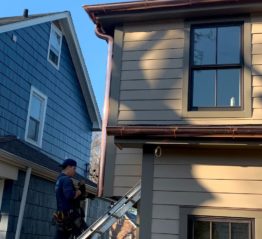
Copper gutters are the premium option, suited to homes with significant architectural character. Copper does not rust, requires no painting, and develops a rich patina over decades that grows more beautiful with time. A properly installed copper system can last 50 years or more.
Galvalume and galvanized steel gutters offer additional strength, particularly relevant in areas subject to heavy snow and ice loads, which is a meaningful consideration in Fairfield County.
Half-round gutters, available in both aluminum and copper, offer a graceful, period-appropriate profile that suits Victorian, Craftsman, Tudor, and Colonial Revival architecture beautifully. Where K-style reads as contemporary and practical, half-round reads as classic and intentional.
“George recommends matching the gutter material and profile to the home,” Michael explains. “A copper half-round on a classic Westport Colonial is an investment that pays for itself in longevity and curb appeal. Aluminum K-style on a newer construction is smart and practical. The right answer depends on the house.”
The Components of a Roof: What to Look for and Ask About

A roof is not a single thing. It is a system of interconnected components, each with its own role and its own vulnerabilities. Understanding what those components are will help you ask better questions during your inspection and make a more informed decision about the home you are considering.
The roof deck is the structural foundation of the entire system, typically made of plywood or oriented strandboard sheathing. Ask about its condition and whether there are any signs of damage, rot, or weakness.
The underlayment sits directly on the deck, beneath the roofing material, and acts as a secondary waterproof barrier. Moisture intrusion is a common issue in Fairfield County, and the quality of the underlayment plays a meaningful role in how well a roof manages it.
The roofing material itself, shingles, metal, slate, or other, is what your inspector will evaluate most visibly. Ask specifically about the material’s age, its manufacturer, and the inspector’s honest assessment of its remaining useful life.
Roof flashing is the metal work at vulnerable transition points, around chimneys, skylights, dormers, valleys, and vents, and it is where most roof leaks originate. Flashing failures are particularly common in Fairfield County’s freeze-thaw climate. “George suggests asking your inspector specifically about the flashing condition,” Michael says. “It’s the thing that fails most often and gets the least attention during a standard inspection.“
Ventilation is the most underappreciated component of any roof system. Proper attic ventilation, through ridge vents, soffit vents, attic fans, or a combination, regulates temperature and moisture, and directly affects the lifespan of the roofing material and the home’s energy efficiency. Attic moisture is a particularly common problem in Fairfield County, and it can significantly impact indoor air quality, promote mold growth, and accelerate the deterioration of the roof deck.
The Components of a Gutter System: What to Look for and Ask About

Gutters are the mechanism that collects water from the roof and safely moves it away from the home. When they are working well, the entire system, roof, siding, foundation, and landscaping, benefits. When they are not, the damage compounds quietly over time.
Gutters themselves are the horizontal troughs along the roofline that collect water as it runs off the roof. Check that they are securely attached, free from visible cracks or rust, properly pitched toward the downspouts, and not sagging in the middle.
Downspouts are the vertical pipes that carry water from the gutters to the ground. Make sure they are correctly connected, undamaged, and not clogged. Equally important: follow them to the bottom and look at where the water goes. Downspouts that terminate directly against the foundation wall are a slow-motion problem.
Elbows and extensions are the angled fittings and horizontal extensions that redirect water flow at the base of the downspout, moving it away from the foundation. Check that they are in place and directing water well clear of the house.
Don't Forget Underground Drainage

On many of the older and larger properties in Fairfield County, the gutter system is only part of the water management picture. French drains, dry wells, and underground piping systems play an equally important role in keeping water away from foundations and out of basements.
Before closing, buyers should ask whether the property has any underground drainage components, when they were last inspected or serviced, and whether the downspouts connect to a dedicated drainage system or simply discharge at grade.
“A French drain that hasn’t been maintained in twenty years may be completely silted in and doing nothing,” George explains. “It looks fine from the outside. You’d never know unless you asked.“
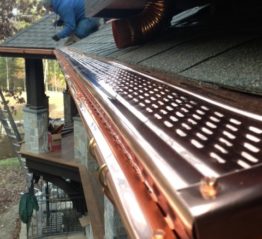
Gutter guards are protective covers that reduce debris accumulation in gutters, minimizing the frequency of cleaning. They are available in a wide range of materials and styles, including copper gutter guards for homes with copper systems. Check whether they are present, what type they are, and whether they appear to be functioning correctly.
“George believes that a clean, well-maintained gutter system is one of the clearest signals that a home has been properly cared for,” he says. “When I pull up to a house, and the gutters are full of debris or pulling away from the fascia, I know we are going to find other deferred maintenance too. It’s almost never just the gutters.“
How to Assess a Roof and Gutter System Before You Ever Set Foot Inside

You can learn a great deal about a home’s roof and gutter condition before you even schedule a showing. Whether you are doing a drive-by, reviewing photos online, or walking the exterior during an open house, here is what to look for.
On the roof, look for missing or damaged shingles, discoloration, and curling or buckling. Check the ridge line; it should be straight and true, with no sagging or waviness. Note any moss or algae growth, which indicates chronic moisture retention. Look for debris accumulation on the roof surface itself.
On the gutters, check that they run straight and are firmly attached to the fascia with no visible sagging. Look for rust, holes, or separated joints. Check for staining on the siding or foundation below the gutter runs, which indicates a history of overflow.
On the ground around the home, look at how the land drains. Does water move away from the foundation or toward it? Are there signs of chronic pooling or erosion near the downspouts?
“George suggests walking around the outside of any home you are serious about, slowly and deliberately,” he says. “Look up and look down. The gutters will tell you a story if you know how to read them.“
While a careful visual assessment is valuable, it is not a substitute for a professional inspection. George’s team is available throughout Fairfield County for roof and gutter inspections, and we are always happy to provide an honest second opinion before you close.
Home Restoration or Repair Gutter Checklist
Bring this when you meet with George’s team. Work through it before you make any decisions.
- Shingles are flat, intact, and free of curling, buckling, or blistering
- No missing or visibly damaged shingles
- Ridge line is straight with no sagging or waviness
- No visible moss, algae, or debris accumulation on the roof surface
- Soffit and fascia boards show no rot, staining, or peeling paint
- No discoloration or water staining on exterior walls below the roofline
- What is the roofing material, and who manufactured it?
- What is the approximate age and estimated remaining useful life?
- What is the condition of the underlayment?
- What is the condition of all: flashing, chimney, skylights, dormers, valleys, vents?
- Is attic ventilation adequate? Are there signs of moisture or mold in the attic?
- Have there been any previous repairs or partial replacements?
- Get an independent roof and gutter inspection from a qualified local contractor
- Request disclosure of any known roof or gutter repairs in the last ten years
- Ask for copies of any material warranties on roofing or gutter systems
- Factor any needed repairs or replacement into your offer price
- Call George at 844-512-2426 for an honest, no-pressure second opinion
- Does the land slope away from the foundation on all sides?
- No signs of chronic water pooling near the home
- Are there French drains, dry wells, or underground drainage components?
- When were they last inspected or serviced?
- Any evidence of water intrusion, efflorescence, or staining in the basement or crawl space?
- Gutters are firmly attached with no visible sagging or separation from the fascia
- No rust, holes, cracks, or separated joints visible
- Gutters are pitched correctly toward downspouts, no standing water visible
- Downspouts are undamaged and not clogged
- Downspouts extend water well away from the foundation
- No overflow staining on siding or foundation below the gutters
- Gutter guards present? What type and condition?
- Seamless or sectional gutters? Age and material?
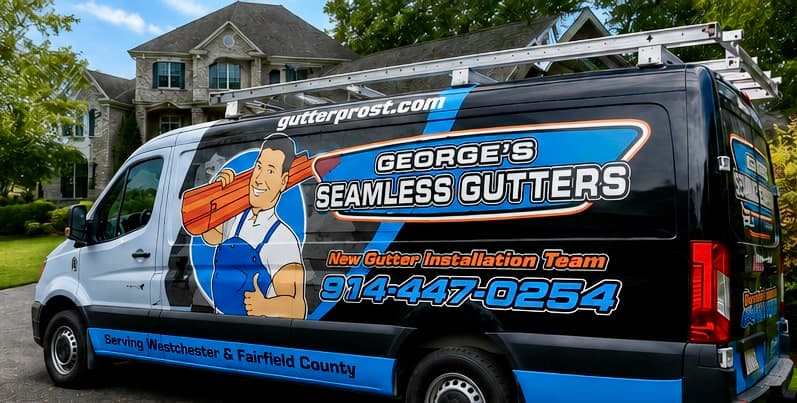
Whether you have a Victorian, a colonial, a contemporary, or anything in between, George’s Seamless Gutters brings the same level of care and expertise to every project. We handle roofing installation of all kinds, including chimney flashing repair and soffit and fascia work. And when the roof is done, we’re the same team you call for gutter installation, seamless gutters, and gutter guards.
One call. One team. One standard of work.
Contact us today for a free estimate. We serve home buyers and homeowners throughout Fairfield County, CT. Call us at 844-512-2426.
George’s Seamless Gutters. Your Newtown neighbor, and Fairfield County’s trusted roofing and gutter specialists.